How Do I Train After Moving Off Campus and Losing the Gym?
Quick Answer: The problem is not equipment — it is that the gym was on your route and your friends were going anyway. Rebuild both: attach training to an existing journey rather than making it a separate trip, and find one person to be accountable to. A minimal home setup of a pull-up bar or door anchor, one resistance band, and one adjustable weight covers almost everything a beginner or intermediate lifter needs.
First year, the gym was a four-minute walk and half your corridor went at six. You trained three times a week without thinking about it.
Now you live twenty-five minutes away, the campus gym costs money you would rather spend elsewhere, and you have been three times since September.

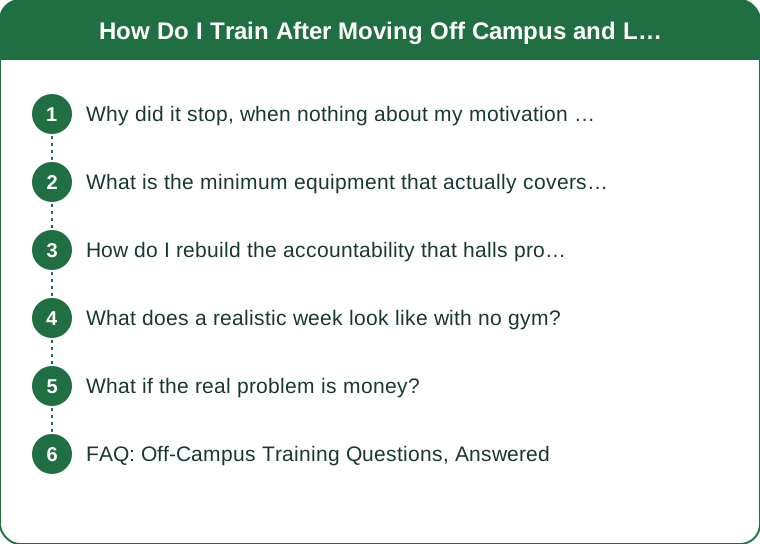
Why did it stop, when nothing about my motivation changed?
Because two structural supports disappeared at once, and neither of them was motivation.
The gym was on your route. In halls, the gym was somewhere you passed. Going required almost no additional travel and no separate decision — it was a detour, not a trip. Living off campus turns it into a dedicated journey, and dedicated journeys have a much higher failure rate. The distance is not the issue; the fact that it is now its own event is.
Your friends were going anyway. Corridor life produces spontaneous accountability. Someone says they are going and you go. That is an enormously powerful mechanism and it is entirely invisible until it is gone. Off campus, going to the gym requires organising with someone, which is a much higher bar than falling in with them.
Two secondary factors:
Your timetable got worse. Later years typically mean fewer, more scattered contact hours, which sounds like more freedom and functions as less structure. Unstructured days are considerably harder to build habits into.
You have more actual responsibilities. Cooking, shopping, bills, a part-time job, a dissertation. The gym is competing with things that did not exist in first year.
Understanding this matters, because the fix is structural. Trying harder addresses none of the four.
What is the minimum equipment that actually covers a full programme?
Less than you think, and it fits under a bed.
The three-item setup:
1. A doorway pull-up bar, or a door anchor for a band. This unlocks all vertical pulling, which is the movement pattern most impossible to train without something to hang from or anchor to. A doorway bar is inexpensive and works in most standard door frames — check yours, and check your tenancy agreement.
2. A set of resistance bands, including at least one heavy loop. Bands cover rows, presses, pull-aparts, assisted pull-ups, and lower body work. The heavy loop is the one that does the most.
3. One adjustable weight. A single adjustable dumbbell, a kettlebell, or even a well-packed rucksack. This lets you load squats, lunges, hinges, rows, and presses progressively, which is the thing bodyweight alone struggles with.
What that covers:
- Push: press-ups at various angles, band presses, overhead press with the weight.
- Pull: pull-ups or band-assisted pull-ups, band rows, single-arm rows with the weight.
- Squat: goblet squats, split squats, step-ups on a chair.
- Hinge: single-leg deadlifts, band pull-throughs, weighted hip thrusts.
- Carry and core: loaded carries down the hallway, planks, hollow holds.
That is a complete programme. Total cost is typically less than two months of a gym membership, it stays with you when you move, and it removes the travel entirely.
The honest limitation: you will run out of load for lower body work fairly quickly, since legs are strong and one dumbbell is not much. Single-leg variations, slower tempos, and higher rep ranges extend it a long way, but if serious lower body strength is your goal, you will eventually want a gym.
How do I rebuild the accountability that halls provided?
Three mechanisms, and you need at least one.
1. One person, one fixed time. Not a group. One person who expects you at a specific time on specific days. This replicates the corridor effect more closely than anything else and it is by far the most effective single intervention.
It does not have to be in person. A message at a fixed time saying done, with the other person doing the same, is genuinely effective — the mechanism is expectation, not company.
2. Attach it to a journey you already make. This is the structural fix for the on-my-route problem.
- Train on campus between lectures, not after going home. Going home first ends the day.
- Use a campus gym on a day you are already there, even if it costs a bit — the travel is already paid for.
- Train immediately on getting home, before sitting down. The commute becomes the cue.
3. A booked, paid, or scheduled commitment. A class, a society, a team. Sports clubs and society sessions are typically cheap, they happen at fixed times whether you feel like it or not, and they solve the social element that was the real loss.
The most underrated option is a university sports club. They exist for every level, they include beginners, the social side is often the point, and they are dramatically cheaper than commercial alternatives. Most people never look.

What does a realistic week look like with no gym?
Three sessions, none longer than forty minutes, arranged around your actual timetable rather than an ideal one.
A workable structure:
Session A — full body, 35 minutes.
- Goblet squat or split squat: 3 sets of 8 to 12
- Press-ups at a scaled angle: 3 sets to two reps short of failure
- Band or dumbbell row: 3 sets of 10 to 15
- Single-leg deadlift: 3 sets of 8 each side
- Plank or hollow hold: 3 sets
Session B — full body, different emphasis, 35 minutes.
- Hip thrust or band pull-through: 3 sets of 10 to 15
- Pull-up progression or band-assisted pull-up: 3 sets
- Step-ups on a chair: 3 sets of 10 each side
- Overhead press: 3 sets of 8 to 12
- Loaded carry down the hallway: 3 sets
Session C — whichever of A or B you did less recently, or something you enjoy: a run, a class, a club session.
Progression, which is the part people skip: add reps until you reach the top of the range, then add load or move to a harder variation. Write it down. Without a record, home training drifts into doing the same thing at the same difficulty for months, which is the main reason people conclude home training does not work.
On timing: put the sessions where your timetable has natural gaps, and treat them as fixed as a lecture. A session with no assigned time happens when everything else has finished, which in practice is never.
What if the real problem is money?
It is, for a lot of people, and it is worth addressing directly rather than pretending equipment is the issue.
Free or near-free options that genuinely work:
- The university gym on a pay-as-you-go basis, used once or twice a week, combined with home sessions. Often much cheaper than a full membership and enough to cover what home training cannot.
- Sports clubs and societies, which are usually a small annual fee for weekly sessions.
- Outdoor calisthenics parks, which exist in most cities and are free. Cold in winter, excellent the rest of the year.
- Running, which costs the price of shoes and is the single cheapest way to build fitness.
- Free class passes and student trial offers, which most commercial gyms run at the start of terms.
- Second-hand equipment. Kettlebells and dumbbells appear constantly on local selling apps at a fraction of retail, and they do not wear out.
On the rucksack option: a rucksack loaded with books or water bottles is a genuinely serviceable weight for squats, lunges, step-ups, and carries. It is not elegant and it works. Several kilograms of textbooks you are not reading is a free adjustable weight.
Where not to spend: apps and subscriptions, before you have a consistent habit. The habit is the constraint, not the programming, and a free written plan you follow beats a paid one you do not.
FAQ: Off-Campus Training Questions, Answered
How do I train in a flat without annoying housemates or neighbours?
Avoid jumping and dropping anything. Bodyweight strength work, bands, and controlled dumbbell movements are near-silent. A mat helps considerably. If you live above someone, skip plyometrics entirely — most of the benefit is available from slow, controlled loaded work anyway.
Is home training as good as a gym?
For general strength, fitness, and health, a well-structured home programme is genuinely effective, particularly for beginners and intermediates. For maximal strength or specific sport goals, the load limitation eventually binds. For the great majority of students, the difference between home training and a gym matters far less than the difference between training and not training.
How do I stay consistent with an unpredictable timetable?
Commit to a number of sessions per week rather than specific days. Three sessions between Monday and Sunday, arranged as the week allows, survives an unpredictable schedule where a fixed Monday-Wednesday-Friday plan does not.
What about winter, when I do not want to leave the house at all?
This is the strongest argument for the home setup. A pull-up bar and one weight in your room means the weather is irrelevant, and December to February is exactly when a travel-dependent plan collapses.
I have not trained in two months. Where do I start?
One session this week. Not three. Pick session A above, do it once, and add the second session next week. Restarting at the volume you used to do is the most reliable way to be sore, discouraged, and finished by week two. This is general information, not medical advice.
TL;DR:
- What you lost was the gym being on your route and friends going anyway — not motivation.
- Minimum kit that covers a full programme: a doorway pull-up bar or door anchor, a heavy resistance band, and one adjustable weight. Under two months of membership.
- Rebuild accountability with one person and one fixed time, not a group.
- Attach training to a journey you already make. Train on campus between lectures, or immediately on getting home.
- Three sessions a week, 35 minutes each, and write down your numbers so you actually progress.
- University sports clubs are the cheapest and most underused option — they solve the social loss too.
- Commit to sessions per week, not specific days. That survives an unpredictable timetable.
Keep Reading
This article is for general informational and styling purposes only. Fit, sizing, and product availability may vary.