How Do I Train During Syllabus Week When Nothing Is Settled Yet?
Quick Answer: Do not try to build your term routine during syllabus week - the schedule you are planning around does not exist yet. Instead run a deliberately minimal placeholder: three sessions of 20 to 30 minutes at fixed times you already know are free, using equipment you do not need to queue for. Then build the real routine in week two, once you know your actual class times, commute pattern, and how tired you actually are. Trying to lock in a perfect plan on day two is the most common reason routines collapse by week four.
Everything is provisional. Classes get moved, sections get swapped, you do not know yet which lecture you can walk to in ten minutes and which one is across campus. Your energy pattern for the term has not emerged.
And this is precisely the week most people try to design a training schedule for the next four months.

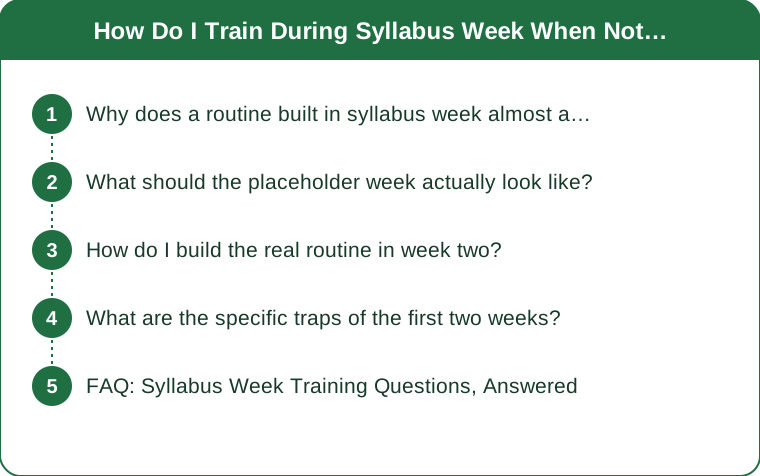
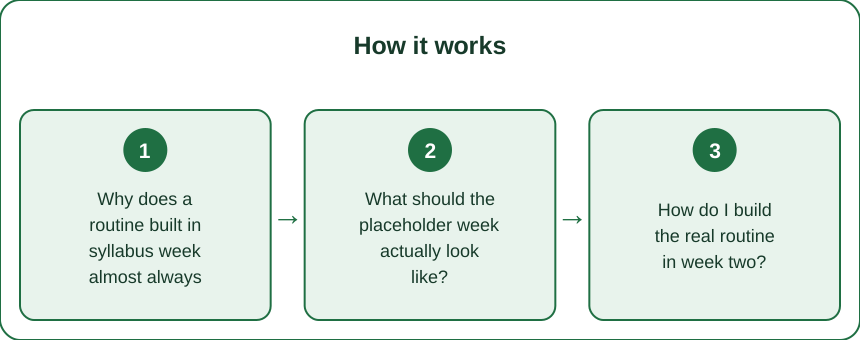
Why does a routine built in syllabus week almost always fail?
Because you are optimising against data you do not have yet.
Three specific things are not known in week one:
Your real schedule. Sections change, a class gets added, the seminar you thought was Tuesday moves to Thursday. Any plan pinned to a timetable that is still moving will need rebuilding, and rebuilding a plan feels like failing at it.
Your real energy pattern. You do not yet know whether your Wednesday is brutal or easy, whether the walk between two buildings is fifteen minutes or thirty, or how much a full day of lectures actually takes out of you. That information arrives in week two and three.
The gym’s real pattern. Campus recreation facilities are at their most crowded in the first weeks of term and then settle considerably. The 5pm queue you plan around in September may not exist in October, and the 7am slot that is empty now may fill up. Planning around week-one crowding gives you a plan optimised for conditions that are about to change.
There is also a motivational trap. The start of term brings a burst of enthusiasm, and enthusiasm designs ambitious plans - six days a week, an hour each. That plan is built by the most motivated version of you and executed by the version who has three deadlines and got five hours of sleep. The gap is where routines die.
So what is the actual goal for week one?
Not progress. Continuity. The purpose of syllabus week training is to keep the habit alive across a disruption, so that week two starts from something rather than nothing. A minimal routine you complete beats an ambitious one you abandon, because the thing you are protecting is the identity, not the training stimulus.
Three short sessions in week one is a success. It genuinely is.
What should the placeholder week actually look like?
Three sessions, 20 to 30 minutes, at times that cannot move, using whatever needs no queue.
How do I pick the times?
Anchor to fixed points rather than free space. The reliable anchors in week one are waking up, and the gap immediately before or after a class you have definitely confirmed. Do not schedule around free afternoons - free afternoons in syllabus week get eaten by administrative tasks, queues, and social plans you did not anticipate.
Morning slots are the most robust, because nothing has had a chance to move them yet. This is a week where 7am is genuinely easier than 5pm, even if you are not a morning person.
What should the sessions be?
Full-body, minimal equipment, no queuing. In week one the squat racks and benches have the longest waits, so a plan that depends on them will fail on logistics alone.
A workable template:
Session A - bodyweight, anywhere: squats, push-ups (incline if needed), reverse lunges, glute bridges, plank. Three rounds, 8 to 12 reps each, about 20 minutes.
Session B - dumbbells or bands: goblet squat, dumbbell row, overhead press, Romanian deadlift, carry. Three sets of 8 to 10.
Session C - cardio you control: a 25-minute run, walk, or bike. Nothing that requires a machine that might be occupied.
Rotate A, B, C. If you miss one, you have missed a third of a placeholder week, which does not matter.
What about intensity?
Keep it moderate - leave two or three reps in reserve. Week one is often short on sleep and high on stress, which is not the ideal context for maximal effort. You are maintaining, not building.

How do I build the real routine in week two?
Collect data in week one, then design against it. This takes about ten minutes.
What to actually track
At the end of each day in syllabus week, note three things on your phone: what time you actually finished for the day, how tired you were on a scale of one to five, and whether you had a genuine gap of 45 minutes or more.
By Sunday you will have a real picture rather than an aspirational one. Almost everyone finds at least one day is far heavier than expected and one is far lighter.
The design rules that hold up
Put your hardest session on your easiest day. Not on the day that feels symbolically right. If Thursday is your light teaching day, that is your big session, regardless of what the plan on the internet said.
Never schedule the session immediately after your longest day. It will be the first one you drop, and dropping sessions is what breaks the identity.
Three fixed days beats five flexible ones. Fixed sessions become automatic; flexible ones require a decision every time, and decisions are what you run out of during term.
Attach sessions to something you already do. Directly after a specific class, or immediately on waking. An anchored habit survives far better than a free-floating one.
Leave one flex slot. One session a week that has no fixed time, to be placed wherever the week allows. This absorbs the inevitable disruption without breaking the other two.
When to expect it to settle
Give it until week four. Weeks two and three are for testing the design and adjusting. By week four you will know whether it holds, and that is the point at which you can start progressing loads rather than just showing up.
What are the specific traps of the first two weeks?
The all-or-nothing restart
The most damaging pattern is deciding that because you cannot do the full planned session, you will do nothing. A 15-minute session is worth roughly 80 percent of the habit value of a 45-minute one, and habit is what you are building in week one. Have a defined minimum - three exercises, ten minutes - that counts as a completed session on a bad day.
Training on genuinely inadequate sleep
First weeks of term run short on sleep, and hard training on five hours raises injury risk and produces poor sessions. The pre-made rule: under five hours, swap for a walk. Deciding this in advance stops it becoming a nightly negotiation.
The campus gym crowd spiral
Going at peak time, waiting 20 minutes, having a frustrating session, and concluding the gym does not work for you. The fix is timing, not abandonment - early morning and mid-morning are consistently emptier, and the crowding drops substantially after the first month.
Getting ill in week three
New environment, new people, poor sleep, high stress - the first weeks of term are reliably when people get sick. It is not a coincidence and it is not bad luck. Protecting sleep in weeks one and two is the highest-value thing you can do for your training in week four.
Comparing your week one to someone else’s
Everyone at the campus gym in the first week looks like they have it figured out. Most of them are also improvising, and a large share will not be there in November. Consistency over the term beats intensity in September by a wide margin.
FAQ: Syllabus Week Training Questions, Answered
Should I just skip week one entirely and start properly in week two?
No. The gap is the risk. A week off during a major schedule disruption is how a routine becomes a former routine - the restart cost is much higher than the maintenance cost. Even two 20-minute sessions preserves the thread.
The campus gym is unusable in the first weeks. What else works?
Dorm bodyweight sessions, outdoor running, and walking are all genuinely effective and have zero queue. A resistance band set costs very little, packs into a drawer, and covers most of what you would do with machines. Crowding drops noticeably after the first few weeks.
How do I train if my class schedule changes every week?
Anchor to waking rather than to classes. Wake time is the only fixed point in a variable schedule, and a session immediately on waking cannot be displaced by a timetable change. Keep one flex slot for the rest.
I trained all summer and week one wrecked me. Is that normal?
Completely. You have added a large cognitive and logistical load and probably reduced sleep, and the training feels harder as a result. Hold the load steady for two weeks rather than pushing - it usually normalises by week three as everything else settles.
TL;DR:
- Do not design your term routine in week one. You are optimising against a schedule and an energy pattern that do not exist yet.
- Run a placeholder: three sessions, 20 to 30 minutes, anchored to fixed times, using equipment with no queue.
- The week-one goal is continuity, not progress. Keeping the thread alive is the whole job.
- Track three things daily - finish time, tiredness, and whether you had a real gap. Design week two against that data.
- Put the hardest session on the easiest day, keep three fixed slots plus one flex, and attach each session to something you already do.
- Have a defined minimum session for bad days, and a pre-made rule to swap for a walk on under five hours of sleep.
The people still training in November are almost never the ones who built the most ambitious plan in September. They are the ones who kept a small thing going through the week when nothing was settled, and then built on it once the term became real.
Keep Reading
This article is for general informational and styling purposes only. Fit, sizing, and product availability may vary.