How Many Days a Week Should a Busy College Student Actually Work Out?
Quick Answer: Three days a week of 30-45 minute sessions is the realistic, sustainable target for most college students — enough to build real strength and consistency without competing with classes, a job, or sleep.
Every January and every September, the same thing happens: a student commits to working out every single day, makes it eight days, and quits entirely for the rest of the semester. The fix isn’t more willpower. It’s picking a frequency your actual schedule can hold, and understanding why the ambitious version keeps failing in the first place.

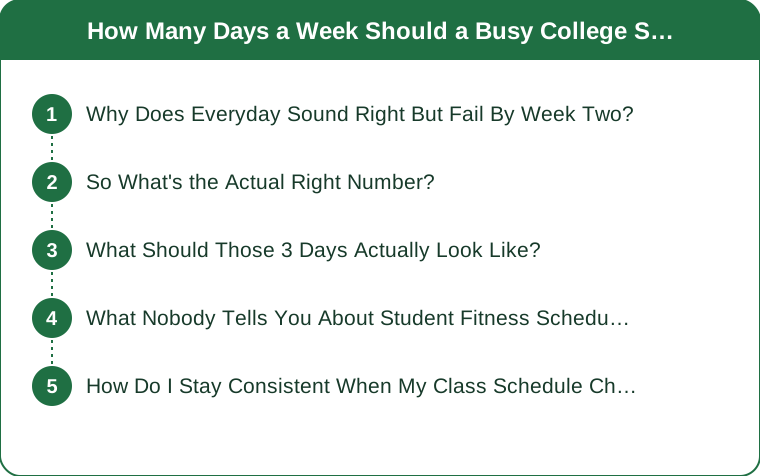
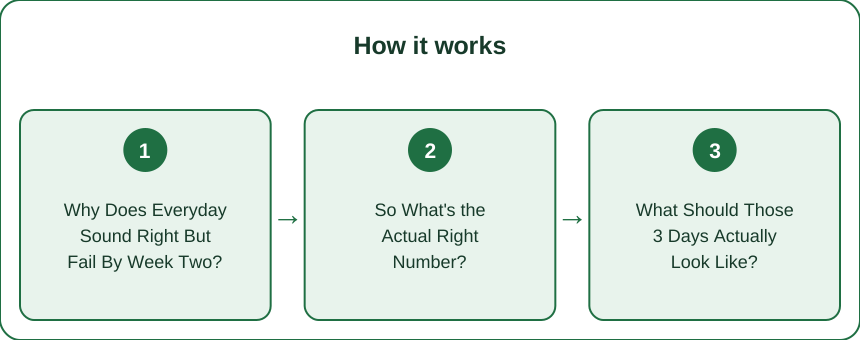
Why Does Everyday Sound Right But Fail By Week Two?
Daily workouts sound disciplined, but they don’t account for the reality of a student schedule: exam weeks, inconsistent sleep from late study nights, part-time work shifts that shift week to week, and social obligations that pop up without warning. When a daily streak breaks once — a missed Tuesday because a paper was due — many students treat it as total failure and stop entirely, a phenomenon researchers call the ‘what-the-hell effect,’ where one lapse triggers abandoning the whole plan rather than just resuming the next day.
A frequency with built-in flex, like 3 days a week from a menu of any 3 days rather than fixed calendar days, survives a missed Tuesday without collapsing the whole plan, because there was never a rigid daily requirement to break in the first place.
So What’s the Actual Right Number?
Is three days really enough to see results? Yes — three sessions of 30-45 minutes each week is enough to build measurable strength and cardiovascular fitness in a beginner, according to general exercise science guidelines, and it’s realistic to fit around a class schedule that changes by semester. Two is workable as a floor during the hardest exam weeks; four is fine if energy allows, but isn’t necessary for real progress, and pushing to four or five before the habit itself is solid often backfires into the same burnout pattern as a daily plan.
Does the type of exercise matter for how many days I need? Strength-focused sessions generally need at least one rest day between working the same muscle groups to allow recovery, which naturally caps effective frequency around 3-4 days for most beginners; cardio-only days can be added more flexibly since they don’t carry the same recovery requirement.

What Should Those 3 Days Actually Look Like?
A simple split works well: one full-body strength session, one cardio session (walking, jogging, or a class), and one flexible day that’s either a repeat of one of those or an active recovery walk. Each session doesn’t need a gym — bodyweight circuits or resistance bands in a dorm room count fully, and a 30-minute session of squats, push-ups, band rows, and glute bridges delivers real strength gains for a beginner without ever stepping into a gym building.
The strength day doesn’t need to be complicated to work: 3 sets of 10-12 bodyweight squats, 3 sets of push-ups (knees down is completely fine early on), a minute of plank, and a set of band rows covers every major muscle group in under 25 minutes. The cardio day can be as simple as a brisk 25-30 minute walk between classes rather than a dedicated gym session — the goal at this stage is elevated heart rate and consistency, not a specific pace or distance.
What Nobody Tells You About Student Fitness Schedules
The semester isn’t a flat 15 weeks — it has predictable low points (midterms, finals) and predictable high points (the first few weeks, right after a big paper is turned in). Nobody tells incoming students to plan around this rhythm instead of fighting it, which is exactly why so many fitness plans quietly die during week 7 or finals week and never restart.
The move: front-load a slightly harder routine during the easy weeks 1-4 and 9-12, and deliberately drop to a bare-minimum 2-day maintenance mode during weeks 6-7 and finals — that’s not quitting, that’s the actual plan working as designed, and treating it as the plan (rather than a failure of the plan) is what lets students pick back up in week 14 instead of having to restart from zero in the spring semester.
How Do I Stay Consistent When My Class Schedule Changes Every Semester?
Anchor the workout to something fixed in your week rather than a clock time — right after your Tuesday/Thursday morning class, or right before your dining hall dinner slot. Fixed-time plans (‘I’ll go at 6pm’) break the moment one class or shift changes; anchored-to-event plans survive schedule shuffles because the anchor moves with you rather than requiring you to remember a specific clock time each new semester.
What if my dorm has literally no gym access?
A resistance band set (under $15) and 20 minutes of floor space covers a full-body strength session — squats, band rows, push-ups, glute bridges — with zero gym required, and the bands pack flat enough to fit in a desk drawer between uses.
Should I work out alone or find a workout buddy in my dorm?
A buddy improves adherence significantly for students specifically, because it converts the workout into a social commitment rather than a solo chore competing with everything else on your calendar — even one consistent workout partner roughly doubles the odds you’re still going in week 10, since showing up becomes about not letting someone else down, not just personal willpower.
What’s the biggest single reason students who start strong in week one quit by week five?
Overambitious frequency almost always outranks the other reasons — starting at five or six days a week before the habit itself is established sets up the exact all-or-nothing collapse that a realistic 3-day plan is specifically designed to avoid.
Does it matter what time of day I work out as a student?
Not for results, but it matters enormously for adherence — a morning session avoids the risk of a spontaneous evening plan or a late study session eating into the slot, while an evening session can double as a stress reset after a long day of classes; the better time is whichever one has historically survived more of your schedule disruptions.
How do I handle the semester when my class schedule has an actual 3-hour gap I could use, versus one where every day is packed back to back?
On a packed-schedule semester, anchor the 3 sessions to the same fixed slot every time it recurs (right after your one recurring class with a gap), even if that means fewer total weekly options — a single reliable slot beats trying to find a different window each day.
TL;DR:
- 3 days a week, 30-45 minutes, is the realistic target — not daily
- Anchor workouts to a fixed event in your schedule, not a clock time
- Plan for lower-effort weeks during midterms and finals instead of fighting them
- A resistance band and dorm floor space is enough on low-access days
- A workout buddy roughly doubles your odds of still going by week 10
- Overambitious frequency, not lack of willpower, is the top reason strong starts collapse by week five
The students who are still working out in April aren’t the ones who started hardest in September — they’re the ones who picked a number their actual semester could survive.
Keep Reading
This article is for general informational and styling purposes only. Fit, sizing, and product availability may vary.