First Semester Fitness: Your Questions, Answered
Quick Answer: First-semester fitness fails for a structural reason rather than a motivational one - your schedule is different every day, so the habit has no fixed anchor. The fix is to attach movement to fixed points that do not change: walking between classes, a specific gym slot on the two days your timetable repeats, and a 15-minute dorm routine for everything else. Consistency at 15 minutes beats an hour you attend twice.
You joined the gym in week one. It is week four and you have been three times.

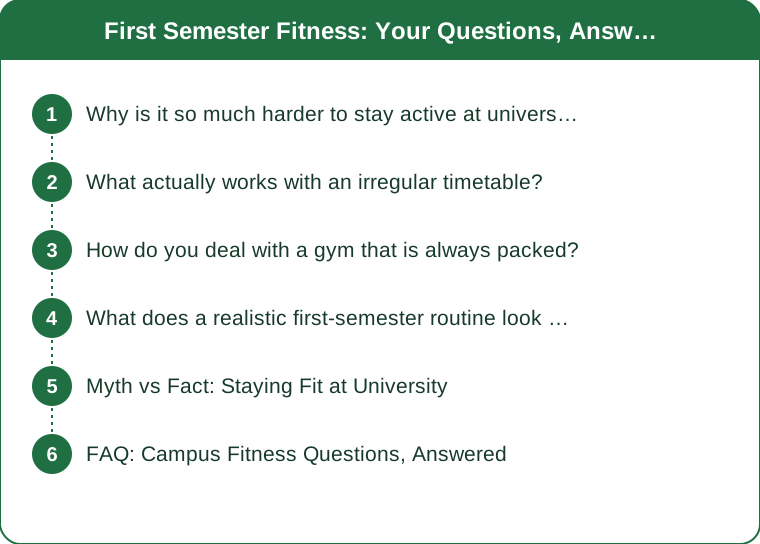
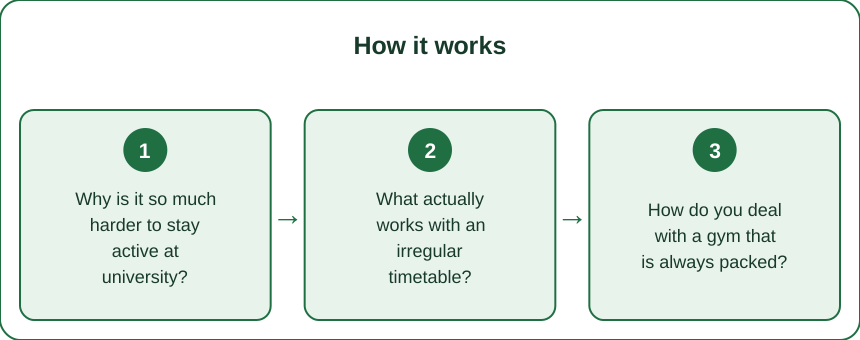
Why is it so much harder to stay active at university?
Four structural reasons, and only one of them is about motivation.
Your schedule is irregular. School and home life run on a fixed daily timetable; a university week has different days with different shapes. Habits are cued by consistent context, and an inconsistent schedule removes the cue. This is the biggest factor and it is entirely structural.
Incidental movement drops sharply. Walking to school, sports, chores, and moving around a house add up to substantial daily activity that mostly disappears. The step count drop between school and university is often larger than any planned exercise could offset.
Nobody is expecting you. School sport had a team and a coach. The external accountability that carried you disappears at exactly the point that everything else in your life becomes negotiable.
Everything else is competing. New social relationships, unfamiliar academic demands, and disrupted sleep all draw on the same limited resource. Exercise is usually the first thing to be dropped, because it has no immediate consequence for dropping it.
What follows from this: the solution is not more discipline. It is finding the parts of your week that do not change and attaching movement to those.
What actually works with an irregular timetable?
Three layers, and you need all three because none of them covers a full week alone.
Layer 1 - the fixed slots. Look at your timetable and find the two or three time blocks that are identical every week. Those are the only slots worth committing to, because they are the only ones a habit can attach to. Two fixed sessions a week that actually happen beats five planned ones that do not.
Layer 2 - the incidental floor. Walking between buildings, taking stairs, walking to the shop rather than getting a delivery. This is where most of your weekly activity will come from whether you plan it or not, so it is worth increasing deliberately. Walking the long way to a lecture costs nothing and adds up across a term.
Layer 3 - the 15-minute fallback. A short bodyweight routine you can do in your room with no equipment, on the days everything else falls apart. The purpose is not the training effect - it is keeping the streak alive, so that returning to layer 1 next week does not feel like restarting.
The mistake almost everyone makes is planning only layer 1, at five sessions a week, and having no fallback when it collapses. The layers exist so that a bad week produces a reduced week rather than a zero week.
How do you deal with a gym that is always packed?
The campus gym problem is real and it is mostly a timing problem with a few workarounds.
The peak hours are predictable: late afternoon and early evening on weekdays, roughly 4pm to 8pm. The gym is frequently near-empty at 7am, at lunchtime, and after 9pm, and almost empty on Friday evenings and weekend mornings.
If you can only go at peak times, change what you do rather than when you go:
- Use a single station and stay there. A dumbbell rack or a squat rack lets you complete a full session without competing for six machines.
- Have a plan before you arrive. Deciding in the gym at peak time wastes most of your session.
- Build a workout that works with substitutions. If the machine you want is taken, know two alternatives.
- Supersets keep you moving and reduce the time you spend holding equipment, which is more considerate and faster.
And the honest alternative: if the gym is genuinely unusable at every hour you are free, stop trying to make the gym work. Running, a bodyweight routine, a class, or a sports club can all deliver more than a gym you attend twice a term.
On feeling self-conscious, which is the unspoken half of this question: everyone in a university gym is more focused on themselves than on you, and a large share of them are also new. Going with one other person removes most of it, and it doubles as the accountability that university strips away.

What does a realistic first-semester routine look like?
A template that survives contact with a real timetable.
Two fixed strength sessions a week, 40 minutes each. Full body both times - squat or leg press, a push, a pull, and something for the core. Full body twice a week is more effective than a split you attend inconsistently, because every session covers everything.
One thing you actually enjoy, once a week. A club, a class, a sport, a run with someone. This is the session that keeps you attached to the whole thing when motivation for the others runs out.
A 15-minute room routine, on demand. Squats, press-ups against a desk or the floor, lunges, plank, glute bridges. Three rounds. No equipment, no travel, no excuse available.
A daily walking floor. Whatever your timetable, aim to arrive at lectures on foot and take stairs. This is the layer that quietly produces most of your weekly movement.
What to drop when the week collapses: the fixed sessions, in favour of the 15-minute routine. Not the reverse - the fallback is the thing that has to survive, because it is what carries the habit through exam periods and bad weeks.
On sleep, briefly: training on four hours of sleep is largely wasted effort and makes everything else harder. In a week where you can have either the gym session or an extra hour of sleep, the sleep is frequently the better training decision. That is not an excuse - it is a genuine priority ordering during a term.
Myth vs Fact: Staying Fit at University
Myth: You need to go to the gym five times a week for it to be worth doing. Fact: Two consistent full-body sessions a week produce meaningful strength gains, particularly for beginners. The gap between zero and two is enormous; the gap between two and five is comparatively modest.
Myth: The freshman weight gain is inevitable. Fact: Changes in weight during a first year are common and are driven mostly by the collapse in incidental activity, irregular eating, alcohol, and sleep disruption. They are not inevitable and they are not primarily about the gym.
Myth: You should train while you are fresh, so mornings are best. Fact: The best time is the time you will reliably attend. Timetable compatibility beats theoretical optimisation, and for many students that means evening or late night.
Myth: If you miss a week you have lost your progress. Fact: A week off costs very little physically. The cost is entirely to the habit, which is why the 15-minute fallback matters more than it appears to.
Myth: You need a proper gym. Fact: Bodyweight training progresses a long way, and for a first year it is frequently more practical. The gym is one option, not the requirement.
Myth: Everyone else has this figured out. Fact: A very large share of students are also in week four having been three times. The people who look like they have a routine mostly built it in second year, after a first year exactly like the one you are having.
FAQ: Campus Fitness Questions, Answered
How do I find time between lectures and coursework?
You mostly do not find it - you attach it to something fixed. Two sessions in slots that repeat every week, plus walking as your baseline, is more realistic than looking for gaps.
Is it worth paying for a gym membership if I only go twice a week?
Compare the cost against what twice a week is worth to you. Many campus gyms are included or heavily subsidised, which changes the maths considerably. If it is a separate paid membership you use twice a week, running and bodyweight training may serve you better.
What if I have never lifted weights before?
Start with machines or bodyweight, learn the basic patterns, and consider one session with a trainer if your gym offers a free induction. Most campus gyms do.
How do I eat reasonably in a dining hall?
Aim for protein at every meal and something green most meals, and do not attempt a restrictive plan during a transition this large. Consistency in the basics outperforms an optimised plan you abandon in week five.
Should I join a sports club even as a beginner?
University clubs typically have beginner intakes and it is one of the most effective moves available - it solves accountability, social connection, and activity simultaneously.
TL;DR:
- Irregular timetables break habits structurally - attach movement to the parts of your week that repeat
- Three layers: two fixed sessions, a daily walking floor, and a 15-minute room routine for bad weeks
- Full-body twice weekly beats a split you attend inconsistently
- Campus gyms empty out at 7am, lunchtime, after 9pm, and on weekend mornings
- When the week collapses, keep the 15-minute fallback and drop the rest
Week four with three visits is the normal starting point, not a failure.
Keep Reading
This article is for general informational and styling purposes only. Fit, sizing, and product availability may vary.