How Do I Build a Workout Routine in the First Two Weeks of Term?
Quick Answer: Do not build the routine in week one. Spend the first fortnight collecting information - when your classes actually run, when the gym is empty, how long the walk takes - and commit to only two fixed sessions a week. Two sessions you never miss beat five you abandon by October, and the schedule you design before you know your timetable is almost always wrong.
The first two weeks are for reconnaissance. Everyone treats them as a fresh start and builds a five-day plan around a timetable that has not settled yet.

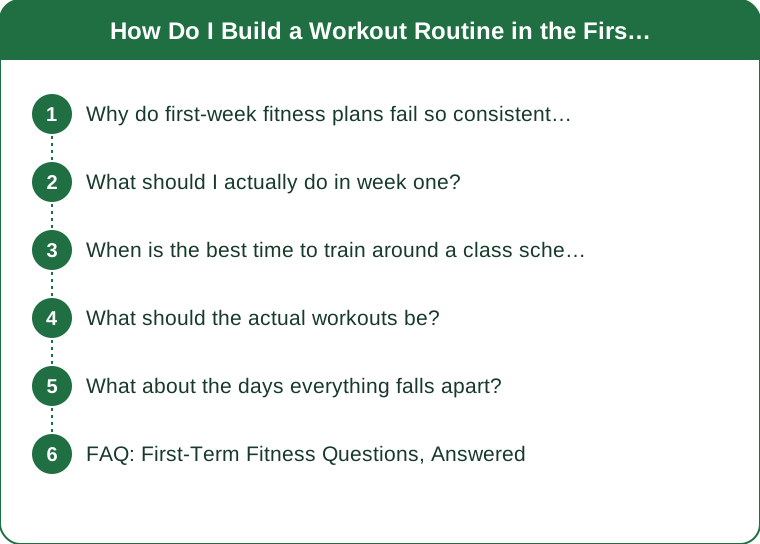
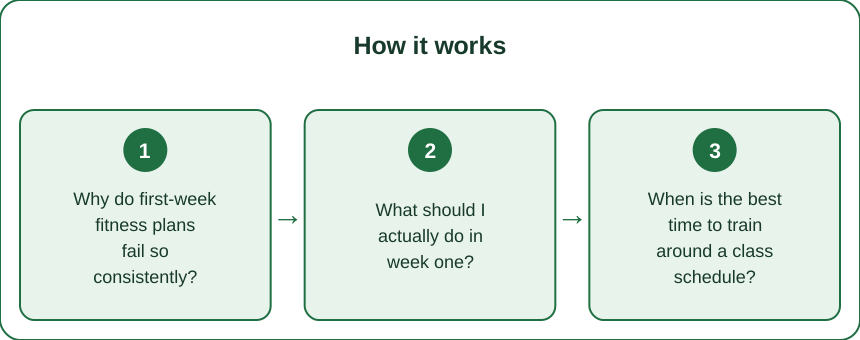
Why do first-week fitness plans fail so consistently?
Because they are built on information you do not have yet.
Three things are unknown in week one. Your real timetable, including the seminars that get moved and the labs that overrun. Your real energy pattern, which is not the one you had at home. And the gym’s real rhythm - which hours are impossible, which are empty.
The plan people write in week one is typically five days, an hour each, in the morning. It is built on optimism and a blank calendar. By week four, the collision with reality has produced not a modified plan but no plan at all, because a five-day plan that becomes a two-day plan feels like failure rather than adjustment.
What actually predicts continued training: starting smaller than you can handle. Two sessions a week that you complete builds an identity as someone who trains. Five sessions a week that you complete twice builds an identity as someone who keeps failing at the gym.
The other reason it fails is social. In the first fortnight, everything is new, everyone is out, and evening plans appear with no notice. A routine built on evenings in the first month is a routine that competes directly with the entire social calendar of the term - and loses, which is not unreasonable.
The recommendation, then: two fixed sessions, deliberately placed where nothing competes, and a policy of adding a third only after both have held for three weeks.
What should I actually do in week one?
Collect five pieces of information and complete two sessions. That is the whole assignment.
What to find out:
- How long the walk to the gym actually takes, door to door, with the bag. Not the map estimate. This number decides whether a 45-minute gap in your timetable is usable
- When the gym is genuinely empty. Most campus gyms have a brutal 5pm to 8pm peak and are near-empty before 9am and after 9pm. Weekday mornings and Friday evenings are the reliably quiet slots at almost every university
- What the access requires - card, app, induction session, booking system. Discovering you need an induction on the day you turned up to train is a classic first-week loss
- Where the gaps in your timetable are, once it has actually settled. Look for the same gap on two or more days
- What else exists. Most campuses have far more than the weights room - classes, courts, a pool, club sessions, drop-in sport. Some of it is free and most students never find out
The two sessions to do in week one: anything at all, in the building, at a time you might repeat. The content of the workout matters far less than establishing that you can get there and back around a class.
A useful trick for the walk: go once with no intention of training. Walk in, look at the layout, find the changing rooms, leave. The unfamiliarity of a new gym is a real barrier and it evaporates after one visit with no pressure attached.
When is the best time to train around a class schedule?
Whenever there is a gap that repeats. Consistency of slot matters more than quality of slot.
The best slots, in rough order:
Morning before your first class. The most protected time in a student schedule because nothing else can be booked into it, and the gym is empty. The cost is that it requires a sleep schedule, which in the first fortnight of term is optimistic.
A repeating gap between classes. If you have a two-hour gap on Tuesday and Thursday, that is the strongest option available - it is already dead time, it repeats automatically, and you are already on campus. This is the single most underused slot.
Straight after your last class. Works well because you are already out, and it fails on the days you go home first. The rule is simple: do not go home first.
Late evening. Quiet, available, and it competes with both socialising and sleep.
The slot to avoid: 5pm to 7pm on weekdays, which is the peak everywhere. Waiting 15 minutes for a rack turns a 40-minute session into an hour and a quarter, and that is how sessions get skipped.
How long should a session be? Forty minutes is plenty and it fits gaps that an hour does not. Two 40-minute sessions completed weekly is a real training stimulus. The belief that a session under an hour is not worth doing keeps more students out of the gym than any other single idea.

What should the actual workouts be?
Full body, twice a week, compound movements, and the same session repeated until it feels easy.
Why full body rather than a split. With two sessions a week, a body-part split means training each muscle group once every ten days or so, which is not enough for progress. Full body twice a week hits everything twice weekly and is straightforwardly the better structure at this frequency.
A workable session, around 40 minutes:
- A squat pattern: goblet squat, leg press, or bodyweight squat. 3 sets of 8 to 10
- A hinge pattern: Romanian deadlift, hip thrust, or back extension. 3 sets of 8 to 10
- An upper body push: push-up, dumbbell bench, or shoulder press. 3 sets of 8 to 10
- An upper body pull: lat pulldown, seated row, or assisted pull-up. 3 sets of 8 to 10
- One core exercise: plank, dead bug, or side plank. 3 sets
Rest 60 to 90 seconds between sets. Choose weights where the last two reps are genuinely hard but your form holds.
Repeat the same session for at least four to six weeks, adding a little weight or a rep when it feels manageable. Variety is the enemy of progress at this stage - repeating the same movements is what lets you see whether you are getting stronger.
If the weights room feels intimidating, which is extremely common and rarely admitted: go at a quiet hour, take a written plan on your phone so you are never standing around deciding, and use the machines for the first fortnight. Machines require no spotting, no setup decisions, and no technique coaching. Moving to free weights later is easy; being put off in week two is not.
On classes and clubs: a booked class solves the scheduling problem entirely because it exists at a fixed time whether or not you feel like it. For a lot of students, one class plus one gym session is a far more durable structure than two solo sessions.
What about the days everything falls apart?
Have a fallback that takes ten minutes, and use it rather than skipping.
The realistic failure modes in a first term are: an overrunning lab, a night out, an assignment deadline, illness, and homesickness. All of them are legitimate and all of them will happen.
The ten-minute fallback: a set of squats, push-ups, and a plank in your room. Three rounds, no equipment, done in the time it takes to make a coffee. The point is not the training effect - it is that the week does not become a zero. A week with two short sessions is a week you continued. A week with none is where routines die.
Other things that count and that students routinely discount:
- Walking to campus, particularly if it is 20 minutes each way. That is meaningful daily activity and it is invisible to most people because it is not called exercise
- Cycling anywhere
- Dancing on a night out, which is genuinely a workout and worth counting rather than treating as an offset against one
- Any club sport, including the informal ones
On the week you miss entirely. It happens, particularly around deadlines and around the first illness of term - and the first term brings a lot of new pathogens into contact with a lot of new people. Missing a week costs you essentially nothing physiologically. Detraining is slow. What it costs is the habit, and the fix is to book the next session before the week ends rather than waiting to feel motivated again.
A note on the pressure specifically. There is a lot of noise around body change in first year, and much of it is unhelpful. Training twice a week for strength, sleeping enough, and eating adequately is a sane baseline. If your relationship with exercise or food becomes distressing or compulsive, most universities have free counselling and health services, and using them early is far easier than using them late. This is general information rather than medical advice.
FAQ: First-Term Fitness Questions, Answered
How many days a week should I train as a first year?
Two, initially. Add a third after both have held for three consecutive weeks. Two completed sessions beat five planned ones by a wide margin.
When is the campus gym least busy?
Weekday mornings before 9am, and after 9pm. The 5pm to 8pm block is the peak almost everywhere and it will double the length of your session.
Is a 40-minute workout long enough?
Yes. Four or five compound exercises for three sets each is a complete session, and 40 minutes fits into gaps that an hour does not.
What if I have never used a gym before?
Start on machines, go at a quiet hour, and take a written plan. Most campus gyms also offer a free induction, which is worth booking in week one rather than week five.
What do I do if I miss two weeks?
Nothing dramatic. Go back to the same session at slightly lighter weight and carry on. Fitness lost over two weeks returns within one or two sessions.
TL;DR:
- Spend week one collecting information, not building a five-day plan around a timetable that has not settled
- Commit to two fixed sessions a week and add a third only after three consistent weeks
- Repeating gaps between classes are the most reliable slot; 5pm to 8pm is the worst
- Full body twice a week with five compound movements, 40 minutes, same session repeated for six weeks
- Keep a ten-minute room fallback so a bad week is short rather than zero
The students still training in November are almost never the ones with the most ambitious September plan.
Keep Reading
This article is for general informational and styling purposes only. Fit, sizing, and product availability may vary.