How Do I Restart a Workout Routine in the First Week of Term?
Quick Answer: Don’t try to restore your summer routine in week one - the schedule isn’t stable enough yet. Commit to a minimum viable version, three sessions of 20-30 minutes attached to fixed points already in your calendar, and hold that for two weeks. Once the timetable settles, expand. The people who still train in November are the ones who started small in September, not the ones who started ambitiously.
You trained four times a week all summer. It’s week one of term, and you’ve been to the gym zero times.
This is normal, it’s predictable, and the fix isn’t discipline. It’s designing for the conditions you’re actually in.

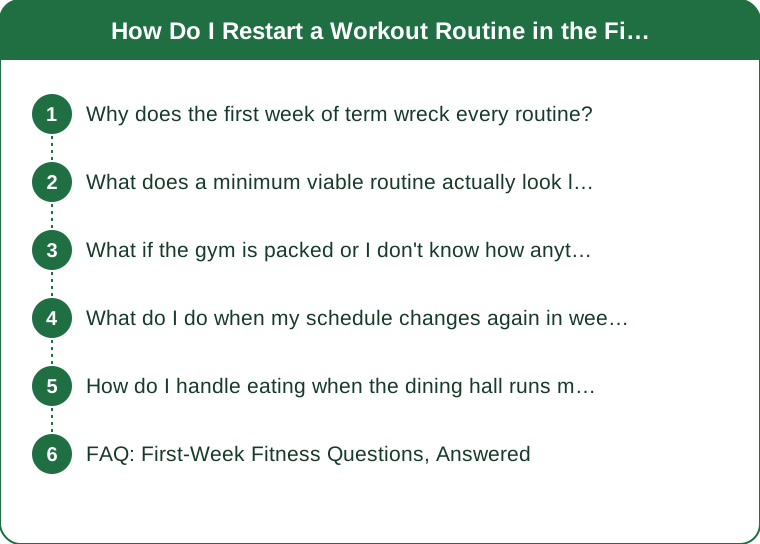
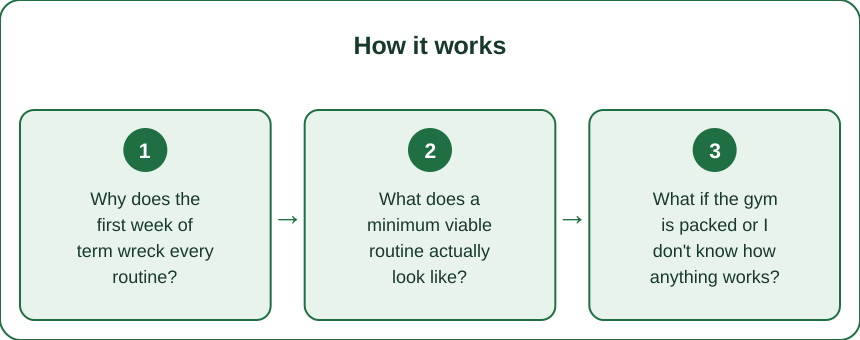
Why does the first week of term wreck every routine?
Three things happen at once, and each one alone would be enough.
Your schedule isn’t stable. Class times shift, sections get added, everything is provisional. A routine attached to an unstable schedule fails by definition - you’re not failing to keep it, there’s nothing solid to attach it to.
Decision load is enormous. New buildings, new people, new systems, new everything. Every decision consumes the same finite resource, and by 6pm the choice to go to the gym competes with a depleted supply.
Your environmental cues are gone. Habits run on context - the same time, the same route, the same bag by the same door. Move to a new place and every one of those cues disappears simultaneously, which is why a habit that felt automatic in August evaporates in a week.
Why this matters: the standard response is to conclude you’ve lost motivation and try to force the old routine back. The old routine was built on a stable schedule and familiar cues, neither of which currently exists. Forcing it produces two good days and then nothing.
The alternative: build the smallest version that works under current conditions, then scale up once the timetable settles in week three or four.
What does a minimum viable routine actually look like?
Three sessions a week, 20-30 minutes each, attached to something already fixed.
The attachment principle is the whole thing. Don’t schedule by time - schedule by attaching to an event that already happens. “After my Tuesday 10am lecture” is far more robust than “Tuesday at 11”, because the lecture happens whether or not you feel like it.
Pick your three anchors now:
- Anchor 1 - after a specific morning class
- Anchor 2 - between two classes with a gap
- Anchor 3 - a weekend slot after something fixed, like a shared meal
What to do in 25 minutes: a full-body session, twice a week minimum, is what preserves strength.
- 5 min warm-up - walk, arm circles, bodyweight squats
- Squat variation, 3 x 8-10
- Push variation, 3 x 8-10 - push-ups, dumbbell press, machine press
- Pull variation, 3 x 8-10 - row, lat pulldown, assisted pull-up
- Hinge, 3 x 8-10 - Romanian deadlift, hip thrust, or a back extension
- Core, 2 sets - plank or dead bug
That’s it. It fits in 25 minutes at a brisk pace, it covers every movement pattern, and it’s genuinely enough to maintain and build in a hectic term.
The two-week rule: run exactly this for two weeks without adding anything. The goal in weeks one and two is attendance, not progression - and resisting the urge to add is the hard part.
What if the gym is packed or I don’t know how anything works?
Both are real barriers, and both have straightforward answers.
Campus gyms are at peak capacity in the first three weeks and then thin out dramatically. Knowing that helps - the crowd you’re navigating in week two isn’t the permanent state.
Off-peak windows on most campuses:
- Before 8am - consistently the quietest
- 11am-2pm - people are in class
- After 8:30pm
- Friday afternoons and Saturday mornings - reliably empty
Peak is 4-7pm on weekdays. If that’s your only option, have a plan that tolerates equipment being unavailable: know a substitute for every exercise so a busy squat rack doesn’t end the session.
On not knowing how things work: most campus gyms include a free orientation or intro session with your fees. Take it in week one - it’s the highest-value 30 minutes available, and it removes the single biggest source of gym anxiety.
If you’d rather not ask: go at an off-peak time, watch how a machine is used, and start with machines rather than free weights. Machines guide the movement path, which makes them far easier to use correctly without coaching.
The honest bit about feeling watched: nearly everyone at a campus gym in September is also new, also unsure, and also focused entirely on themselves. The self-consciousness is real and the audience isn’t.

What do I do when my schedule changes again in week three?
Expect it and design for it, rather than treating it as a setback.
Timetables commonly shift once or twice in the first month - a section moves, a lab gets added, a club meeting lands on your gym slot. A routine built on time slots breaks; a routine built on anchors adapts.
The re-anchoring process, 10 minutes:
- Print or open the new week’s fixed commitments
- Find every gap of 45 minutes or more
- Pick three, attached to the thing immediately before them
- Write them in the calendar as events, not intentions
Have a fallback session that needs nothing. For the weeks where the gym genuinely doesn’t fit: 20 minutes in a dorm room - squats, push-ups, lunges, glute bridges, plank, three rounds. It’s not optimal and it keeps the habit alive, which is what actually matters across a term.
The rule that saves routines: never miss twice. One missed session is a scheduling event. Two in a row is the beginning of stopping, and the evidence on habit formation consistently shows a single lapse has almost no effect while consecutive ones do.
On adding more: once you’ve held three sessions for three consecutive weeks, add a fourth. Not before. The most common failure pattern is expanding in week two, missing the expanded version, and abandoning the whole thing.
How do I handle eating when the dining hall runs my life?
A few specific adjustments, not a diet.
Protein is the thing most likely to be short. Dining hall meals skew heavily toward carbohydrates, and protein is what supports recovery from training and keeps you full between meals.
Practical protein sources in a dining hall:
- Eggs at any meal, not just breakfast
- Greek yoghurt or cottage cheese from the breakfast bar
- Grilled chicken or fish at the main line
- Beans and lentils from the salad bar - usually the most overlooked option
- Milk with meals - straightforward and effective
Aim for a protein source at every meal rather than tracking numbers. That single habit closes most of the gap.
Keep something in your room for the days when meal times and class times don’t line up: nuts, tinned tuna, protein powder, oats, fruit. The dining hall isn’t always open when you’re hungry, and delivery apps are how student budgets disappear.
Fuel around training rather than trying to train fasted. Something with carbohydrate 60-90 minutes before, and protein within a couple of hours after, is all the timing that matters at this level.
And on the freshman fifteen framing: weight change in the first year is common, driven mostly by large shifts in activity, sleep, and eating patterns all at once. Regular movement and a protein source at each meal address the actual mechanism far better than restriction, which tends to fail badly under high stress and irregular schedules.
FAQ: First-Week Fitness Questions, Answered
Is three sessions a week really enough?
For building and maintaining general strength, yes - three full-body sessions covers every movement pattern with enough weekly volume for steady progress. Four is better if it’s sustainable, and three you actually do beats five you plan.
Should I work out in the morning or evening?
Whichever is more protected in your schedule. Mornings are less likely to be eaten by unexpected commitments; evenings are usually better for performance. Reliability beats optimisation in a term-time schedule.
What if I’ve never lifted weights before?
Start with machines and bodyweight, take the free gym orientation, and use 3 sets of 8-10 as your default. Add weight only when the last rep of the last set is still comfortable. That progression rule handles most of the first three months.
How do I work out with no privacy in a shared room?
Bodyweight work needs a mat’s worth of space and no equipment. Silent options - squats, lunges, glute bridges, planks, wall sits - avoid the noise problem. A resistance band adds a lot of range for very little space or money.
I’m too tired after class. What do I do?
Try attaching a session to a morning gap instead, before fatigue accumulates. If that’s impossible, shorten to 20 minutes and lower the intensity - a short easy session preserves the habit, and the habit is what carries you to the weeks when energy returns.
TL;DR:
- Week one instability breaks routines by design - it isn’t a motivation failure
- Build a minimum viable routine: three sessions, 20-30 minutes, full-body
- Attach sessions to fixed events, not to clock times - anchors survive timetable changes
- Campus gyms are packed for three weeks then quiet down; off-peak is before 8am, midday, and after 8:30pm
- Never miss twice - one lapse is nothing, two consecutive ones start the slide
- A protein source at every dining hall meal covers the biggest nutritional gap
- Expand only after three consistent weeks
The students still training in November started small in September. That’s the entire difference.
Keep Reading
This article is for general informational and styling purposes only. Fit, sizing, and product availability may vary.