How Do I Train When the Campus Gym Is Packed in September?
Quick Answer: Campus gym traffic peaks in the first 4 to 6 weeks of fall term and typically drops 30 to 50 percent by mid-October. Until then, train at the genuine off-peak windows - before 8 a.m., during the 12 to 1 p.m. class block, or after 9 p.m. - and switch to a program built around 3 or 4 compound lifts plus dumbbells rather than a machine circuit. Flexibility of exercise order matters more than time of day.
Everything about September gym crowding is temporary. Building a routine that survives it is what determines whether you are still training in November.

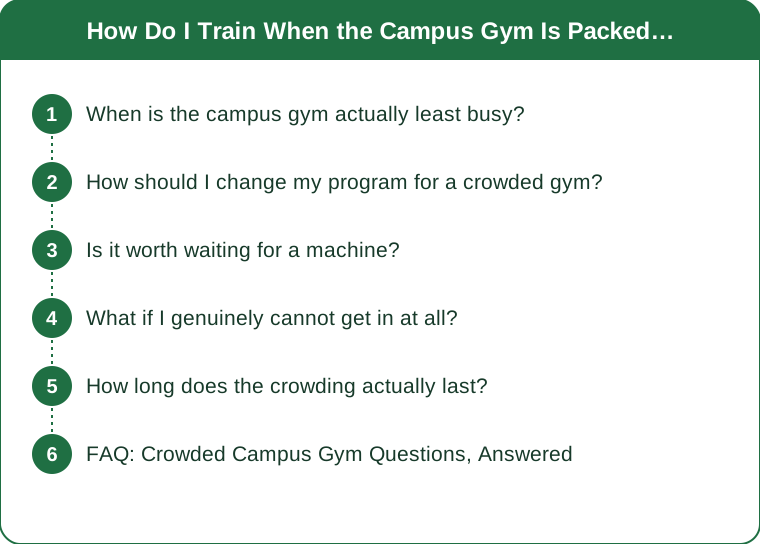
When is the campus gym actually least busy?
The peak is remarkably consistent across universities: 4 p.m. to 7 p.m. on Monday through Thursday. That window is when classes end and before evening commitments start, and it can be three to four times busier than the daily average.
The reliable off-peak windows are narrower than people assume:
- 6:30 to 8:00 a.m. - genuinely quiet almost everywhere, especially Monday and Friday.
- 12:00 to 1:00 p.m. - a real dip on campuses where a common class block runs then.
- After 9 p.m. - progressively emptier, though check closing time before you build around it.
- Friday afternoon - often the quietest weekday slot of the entire week.
- Sunday morning - reliably empty until about 11 a.m.
If your schedule only allows 4 to 7 p.m., that is workable, but you need a different program rather than a different attitude - which is the next question.
How should I change my program for a crowded gym?
The core principle: eliminate any exercise that requires a specific piece of equipment at a specific moment.
A machine circuit is the worst possible design for September. Twelve stations, each of which might be occupied, and the whole thing falls apart if station four is taken.
What works instead is a program with two properties. First, exercise order is flexible - you write down 5 movements and do whichever is free. Second, each movement has a substitute that hits the same pattern with different equipment.
A practical example:
- Squat pattern: barbell squat, goblet squat, or Bulgarian split squat
- Hinge: deadlift, dumbbell RDL, or hip thrust
- Push: bench, dumbbell press, or push-ups with feet elevated
- Pull: row, lat pulldown, or single-arm dumbbell row
- Carry or core: farmer carry, plank variation, or dead bug
Any of those five, in any order, with any of the listed substitutions, is a complete session.
Is it worth waiting for a machine?
Almost never. The math is unforgiving.
A typical session should run 45 to 60 minutes. Waiting 8 minutes for a leg press twice in a session burns a quarter of your training time standing still, and standing still means cooling down, losing focus, and usually cutting the last exercise.
There is one exception: if you are three sets into a working weight and someone is finishing their last set, waiting 90 seconds is fine. Waiting for someone who just started, or who is doing drop sets, is not.
The better habit is to ask to work in. It is standard gym etiquette, most people say yes, and on a busy squat rack it roughly doubles the throughput. If the weights differ a lot, offer to reset the bar between sets - people almost always agree when you make it easy for them.

What if I genuinely cannot get in at all?
Have a dorm-room fallback that you consider a real session rather than a consolation prize.
A 25-minute bodyweight session with the same movement patterns produces real strength adaptations, particularly in the first year of training. Push-ups, Bulgarian split squats with a chair, single-leg hip thrusts, and rows on a sturdy table edge cover four of the five patterns.
Add one resistance band - a long loop band costs very little and packs into a drawer. It unlocks banded rows, pull-aparts, and assisted or resisted variations on everything else.
The research point worth knowing: training frequency predicts long-term results far better than session quality does. Three imperfect sessions beat one excellent session and two skipped ones, especially in a term where your schedule will be unpredictable anyway.
Walking counts too. A 30-minute walk between classes is not a substitute for lifting, but it is meaningfully better than the alternative and it is the easiest thing to keep during exam periods.
How long does the crowding actually last?
Attendance data across university recreation centers follows a strikingly consistent curve. Traffic peaks in weeks 2 through 5 of fall term, declines steadily through October, and by early November sits 40 to 60 percent below the September peak.
There is a smaller secondary spike in January and then another decline by February.
The practical implication: do not redesign your life around September conditions. Get through six weeks with a flexible program and off-peak timing, and the gym you actually train in for the rest of the year is the quiet one.
It also means September is a bad month to start a rigid program that specifies exact exercises on exact days. Start with the flexible template, then tighten it in October when the equipment is reliably available.
FAQ: Crowded Campus Gym Questions, Answered
Should I switch to a commercial gym off campus?
Usually not worth it for six weeks. Campus membership is typically included in fees, and the commuting time will cost you more sessions than the crowding does.
Is it rude to superset in a busy gym?
Using two pieces of equipment at once during peak hours is generally frowned on. Pair a station with a bodyweight movement instead - squat rack plus push-ups works and occupies only one station.
What time should I go if I only have evenings free?
After 8:30 p.m. is noticeably better than 5 p.m. If the gym closes early, Friday and Sunday evenings are typically the emptiest of the week.
TL;DR:
- Peak campus gym traffic is 4 to 7 p.m. Monday through Thursday, and it drops 40 to 60 percent by November.
- Real off-peak windows: before 8 a.m., the noon class block, after 9 p.m., Friday afternoon, Sunday morning.
- Build a flexible 5-pattern program where order can change and every movement has a substitute.
- Do not wait more than about 90 seconds for equipment - ask to work in instead.
- Keep a 25-minute dorm fallback with a band. Frequency beats session quality over a term.
September is the hardest six weeks of the gym year. Plan for them specifically and you will still be training when everyone else has stopped.
Keep Reading
This article is for general informational and styling purposes only. Fit, sizing, and product availability may vary.