Move-In Week Fitness Questions, Answered
Quick Answer: Do not try to build a routine during move-in week — try to keep one thread alive. Ten minutes a day, same time, in your room, is worth more than a perfect gym plan you start in week three. The students who are still training in November are the ones who never fully stopped in August.
Everything is new at once: the room, the schedule, the food, the people, the bed that is somehow both too high and too hard.
And every fitness plan you had in July assumes a version of your life that no longer exists. These are the questions that actually come up in the first ten days.

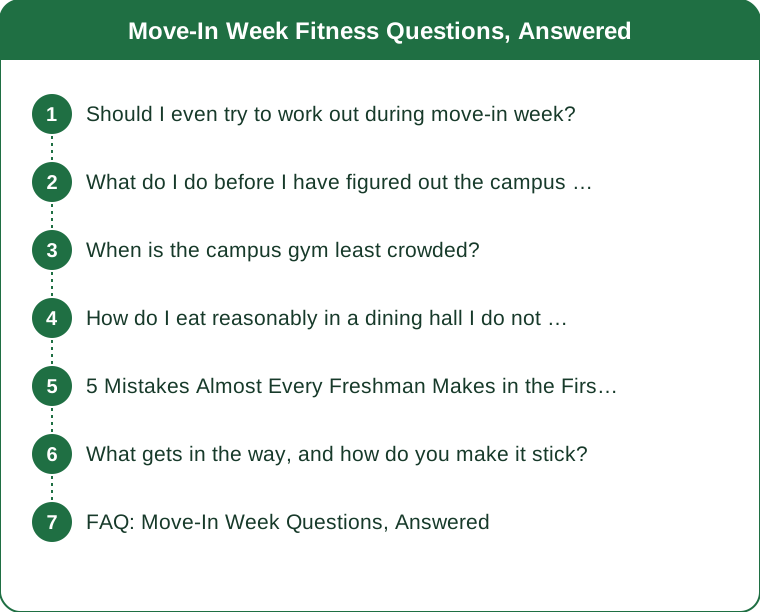
Should I even try to work out during move-in week?
Yes, but redefine what counts. The mistake is treating week one as a launch — you set an ambitious schedule, miss it three days running because orientation ran long, and quietly conclude you will start fresh next month.
The goal for move-in week is continuity, not progress. Ten minutes daily, at a fixed time, in your room, with no equipment. That is a complete and legitimate plan for this specific week.
Why it matters more than the volume suggests: routines that survive a disruption tend to survive the next one too. The habit is being built out of not stopping, and week one is the hardest disruption of the entire year.
So the honest answer is that a 10-minute bodyweight circuit you actually do beats the hour-long gym session you plan and skip. Take the small guaranteed win.
What do I do before I have figured out the campus gym?
You will not know the gym’s real hours, the busy windows, or where anything is for at least a week. Do not wait for that.
A room-sized circuit that needs nothing:
- 10 squats — slow down, quick up
- 8 push-ups — on the floor, or on the edge of the desk if floor push-ups are not there yet
- 20 seconds of a plank
- 10 reverse lunges per leg
- 30 seconds of marching in place
Three rounds, about 10 minutes, 60 seconds rest between rounds. No jumping — your downstairs neighbor is a real person and dorm floors transmit everything.
If you have a resistance band, bring one; it is the single most useful piece of dorm equipment for the space it takes, and it fills the gap that bodyweight training leaves for pulling movements. A doorframe and a band covers rows and pull-aparts for the price of a lunch.
When is the campus gym least crowded?
The pattern is remarkably consistent across schools: the crush is 4 p.m. to 8 p.m. on weekdays, and it is at its absolute worst in the first three weeks of the semester before attendance thins out.
The reliably quiet windows are before 9 a.m., the 11 a.m. to 1 p.m. lunch block if your schedule allows it, and after 9 p.m. Friday afternoons and Saturday mornings are usually near-empty.
Two practical notes for week one. First, most campus gyms require an orientation, a waiver, or a card activation before you can use the weights area — find that out in the first few days rather than showing up ready to train and being turned away. Second, walk through the space once when you are not planning to work out. Knowing where the locker rooms, water, and squat racks are removes most of the friction of a first session.

How do I eat reasonably in a dining hall I do not know yet?
The dining hall problem is not lack of options — it is that everything is available all the time with no natural stopping point.
One structural habit handles most of it: build the plate around a protein first, then vegetables, then the carbohydrate. Not because carbs are bad, but because protein and vegetables are what get crowded out when you fill the plate in the other order, and protein is what keeps you full through a 3 p.m. class.
A rough target that works for most students: a palm-sized protein at each meal, plus something green at two of them.
Also worth knowing early — the salad bar usually has the cheapest reliable protein on campus (eggs, beans, chickpeas, cottage cheese, tuna), and it is open when the hot line has nothing you want. And take a piece of fruit for later; the 4 p.m. vending machine decision is much easier when something is already in your bag.
Skipping meals to “save” the calories for later almost always backfires into a much larger evening. Eat the lunch.
5 Mistakes Almost Every Freshman Makes in the First Month
1. Starting a six-day program in week one. Your schedule is not stable yet. A six-day plan built on a timetable you have not lived through will collapse by the second week, and it takes your confidence with it. Start at three days and add.
2. Working out at a time that competes with class. Anchor the session to something fixed instead — before your first class, or right after the same class every day. Floating sessions are the ones that disappear.
3. Comparing yourself to the person next to you in a campus gym. Some of them are varsity athletes on structured programs and a lot of them are in their fourth year of training. The comparison is not information about you.
4. Treating sleep as the flexible resource. It is the one that makes everything else work, and first-semester sleep debt hits performance in both the gym and the classroom faster than most students expect. Seven hours is the floor, not the aspiration.
5. Not drinking water because the bathroom is down the hall. It sounds trivial and it is genuinely common. Keep a bottle on the desk and refill it on the way back from every class.
What gets in the way, and how do you make it stick?
What if my roommate makes it impossible?
This is the most underrated obstacle of the first month, and it has practical answers rather than motivational ones.
If it is a noise problem — no-jump circuits solve almost all of it. Squats, lunges, planks, glute bridges, and band work are effectively silent. Save anything with impact for the gym.
If it is a space problem — you need about the footprint of a yoga mat. Lounges, study room corners, stairwells, and the grass outside all work, and outdoor sessions in the first weeks are genuinely pleasant while the weather holds.
If it is a privacy problem — working out in front of a new roommate is uncomfortable for a lot of people and there is no need to power through it. Find their class schedule, use that window, or move the session outside.
If it is a schedule conflict — have the conversation in week one rather than week six. Roommate agreements about quiet hours and shared space are much easier to set before resentment accumulates. Most roommates say yes immediately when asked directly.
How do I make this stick past September?
The dropoff is real and it is predictable — it lands somewhere around the first round of midterms, when the schedule tightens and the sessions are the first thing cut.
The single most protective habit is scheduling movement like a class. A block in the calendar, at a fixed time, treated with the same default-yes as a lecture. Things that live in the calendar survive busy weeks; things that depend on motivation do not.
Second: have a defined minimum for bad days. Ten minutes in your room, no gym required, no changing clothes required. The minimum exists so that a hard week costs you intensity rather than the whole habit.
Third, and most effective for most students: train with one other person. Not a group, not an app — one person expecting you at a specific time. Showing up for someone else is a far stronger motivator than showing up for a plan, and the freshman who finds a training partner in September is usually still training in April.
If you are managing an injury, a chronic condition, or an eating disorder history, loop in campus health services early. Most schools include this in tuition and it is dramatically easier to set up before the semester gets heavy. This is general information, not medical advice.
FAQ: Move-In Week Questions, Answered
Is it normal to gain weight freshman year?
Some change is common, and the average is much smaller than the “freshman 15” phrase suggests — studies generally put it in the low single digits of pounds. It is also driven mostly by sleep disruption, alcohol, and irregular meals rather than by dining hall food itself.
Do I need a gym membership if my campus has a gym?
Almost never for the first semester. Campus facilities are already included in your fees, and they are usually well equipped. Reassess in the spring if the hours genuinely do not fit your schedule.
How soon should I start a real program?
Give it two to three weeks. Once you have lived through your actual timetable, you will know which days are realistic — and a program built on real data survives far longer than one built on the schedule you imagined in August.
TL;DR: Move-in week is not the week to build a routine — it is the week to avoid losing one.
- Ten minutes daily in your room beats a perfect gym plan starting in week three.
- Use a no-jump bodyweight circuit until you have the gym figured out; a resistance band is the best dorm purchase you can make.
- Avoid 4 to 8 p.m. at the campus gym, especially in the first three weeks, and sort out the orientation or card activation early.
- Build the dining hall plate protein first, and do not skip lunch to bank calories.
- Start at three days, not six, anchor sessions to a fixed class, and protect sleep.
- Find one training partner — it is the strongest predictor of still training in the spring.
Week one is chaos for everyone. Keep the thread alive and build the real thing in week three.
Keep Reading
This article is for general informational and styling purposes only. Fit, sizing, and product availability may vary.